
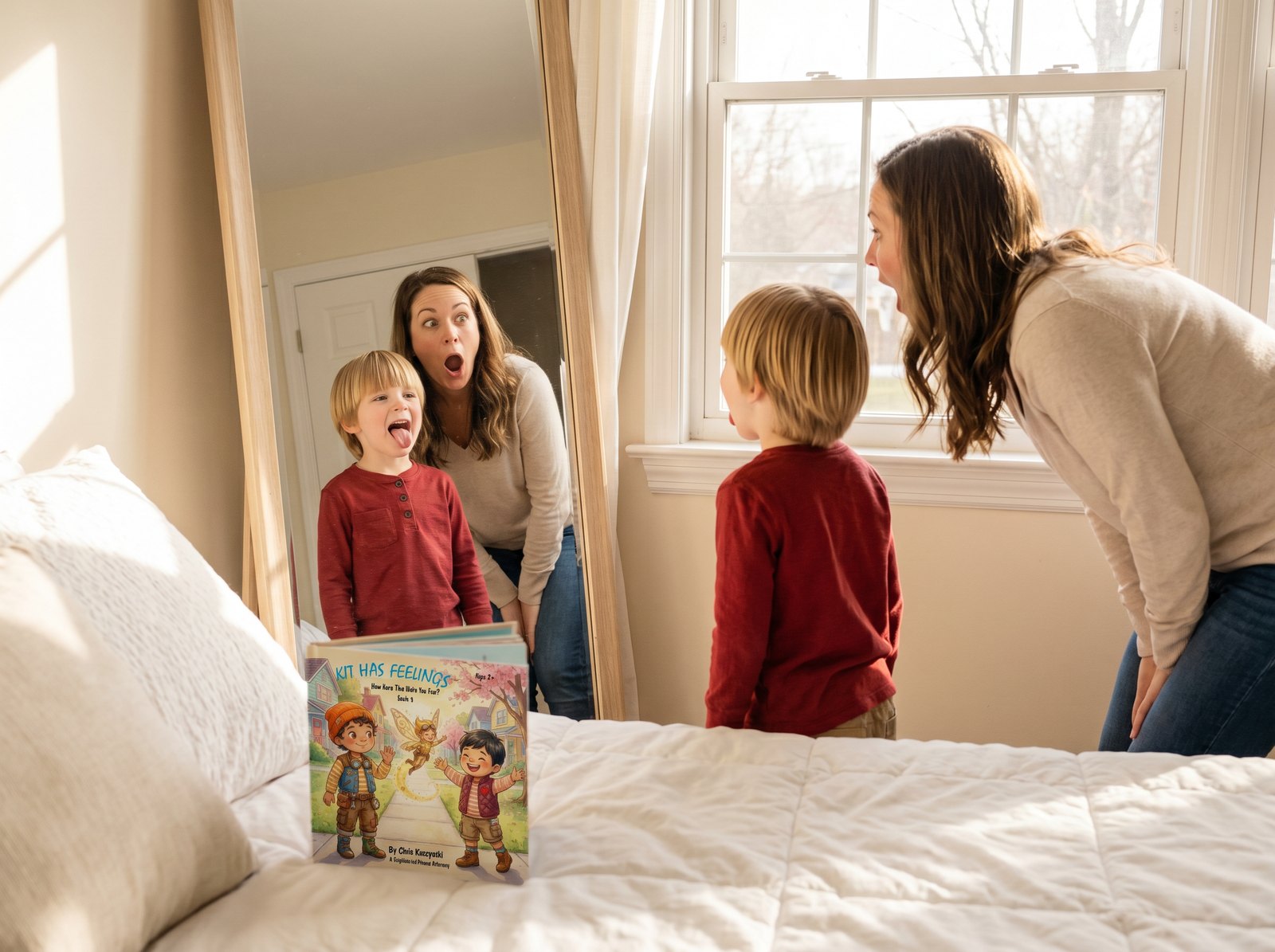
You pick up your child and ask how the day went. “Bad.” You ask why. A shrug. Twenty minutes later, over a snack, it comes out: a friend took the red truck. The word for that was sitting there the whole time. Frustrated. A three-year-old who can name the feeling can hand it to you at the door. A three-year-old who does not has a shrug.
California put that word first. Its 2024 preschool foundations open the social and emotional domain with emotional knowledge, the ability to recognize a feeling and put a name on it, and one picture book we recommend is built on a single question that does exactly that work.
Name the feeling: what California asks
In 2024 the California Department of Education published new Preschool/Transitional Kindergarten Learning Foundations, the document every state preschool and TK classroom in California plans against. The Social and Emotional Development domain opens with a strand called Self, and inside it sits the sub-strand Emotional Knowledge. Foundation 1.3, “Understanding Emotions in Self and Others,” describes the early level, ages three to four, in one line:
“Identify basic emotions (for example, happy, sad, surprised) and recognize emotional expressions in self and others.”
California Department of Education, Preschool/Transitional Kindergarten Learning Foundations: Social and Emotional Development, 2024, p. 21
A year later the bar moves up: “Identify basic and complex emotions (for example, embarrassment, prideful) and recognize emotional expressions in self and others” (California Department of Education, 2024, p. 21). The document also describes the adult’s half. “Teachers can also demonstrate responsiveness by identifying children’s emotions, behaviors, and needs and consistently responding to each child in ways that meet their individual needs” (p. 10). Recognize the feeling. Put a word on it. Respond to the word. NAEYC’s position statement on developmentally appropriate practice lists social and emotional development among the domains where each one “both supports and is supported by the others” (NAEYC, 2020, p. 9), and CASEL, whose five-competency framework most social and emotional programs are built on, files the same skill under self-awareness.
Why the word beats the description
Most children’s books do feelings through the body. A tight tummy. A wobbly lip. Cheeks that get hot. Those are fine as a second channel, but a three-year-old cannot use them as a first one. “My tummy is tight” gives a child nothing to say to a friend. “I feel frustrated” does. The word is the tool. Once a child has it, they can hand it to you, and you can do something with it. That is the practical reason the foundation asks for a label rather than a metaphor, and it is why the books we recommend name the feeling out loud, every time, before anything else happens.
A book that meets the goal

Kit’s Little Sparks, Book 4
Kit Has Feelings: How Does That Make You Feel?
Bao asks one question, “How does Mia FEEL?”, then asks it about every face they meet, and the child answers before you can.
“How does Mia FEEL?” Bao asks it once, after Mia’s cup tips over and three of Kit’s fixes fail, and Kit does not know. So they practice on the neighbors. Mr. Gomez cannot open his jar. Frustrated. The dog walker is tangled in her leashes. Silly. Each page pairs the scene with one big, expressive face a child can point at and copy. Then the book slows down. A little girl cannot reach the water fountain, and her feeling is quieter than the others. Small. The page gives it extra room on purpose, because not every feeling is loud, and the quiet ones are the ones adults miss. Back home Kit looks at Mia’s face, really looks, and finds the word. Sad.
How the book meets what the standard asks for. The foundation asks a three-year-old to identify basic emotions and recognize them in others. Book 4 is a page-by-page rehearsal of exactly that, name the feeling first: one scene, one face, one word, and a question that waits for the child to supply it. The later level asks for complex emotions, and the book’s quiet page, “small,” is the first step toward them. Two later books keep the habit going. In Book 7 Kit’s invention collapses and his lip wobbles before anything else happens. In Book 13 a kid at the playground claims Kit’s idea, and the story stops to name what that feels like, Kit’s face goes hot and his hands go tight, MAD, before anyone talks.
Chris Kuczynski wrote about the same foundation for families on the Little Sparks site in Name the Feeling First. This post is the classroom side of that conversation, and the social and emotional strand of any preschool curriculum is where the word gets practiced during the school day.
What you can do
- Ask Bao’s question once per page and wait. “How does Mia feel?” Then nothing. The silence is where the label gets found.
- Keep four face cards near the reading spot: happy, sad, frustrated, silly. A child who has no word yet can point.
- Use the same word for your own feeling that day. “I felt frustrated when the printer jammed.” The label travels.
Tonight, when the juice tips over at your own table, try the question before the paper towel. Name the feeling, then wipe.
References
- California Department of Education. (2024). California preschool/transitional kindergarten learning foundations: Social and emotional development. Original PDF. Archived copy on littlesparksbooks.com (PDF), saved in case the original moves.
- CASEL. (n.d.). What is the CASEL framework? casel.org/fundamentals-of-sel/what-is-the-casel-framework
- Kuczynski, C. (2026, August 28). Name the feeling first: What California’s preschool foundations ask, and how Bao does it. The Inventor’s Desk. littlesparksbooks.com/blogs/news/name-the-feeling-first-california-preschool-foundations-book-4
- National Association for the Education of Young Children. (2020). Developmentally appropriate practice [Position statement]. Web version at naeyc.org. Original PDF. Archived copy on littlesparksbooks.com (PDF), saved in case the original moves.
Written by Chris Kuczynski. The books recommended here are his.
Chris Kuczynski is an engineer turned registered patent attorney, a preschool co-founder, and a dad. He is the author of Kit’s Little Sparks, a 20-book STEM series that gives children ages 2 to 4 the social and emotional foundations of the inventor’s mindset. It is the first of four age-tiered series for readers ages 2 to 12.