
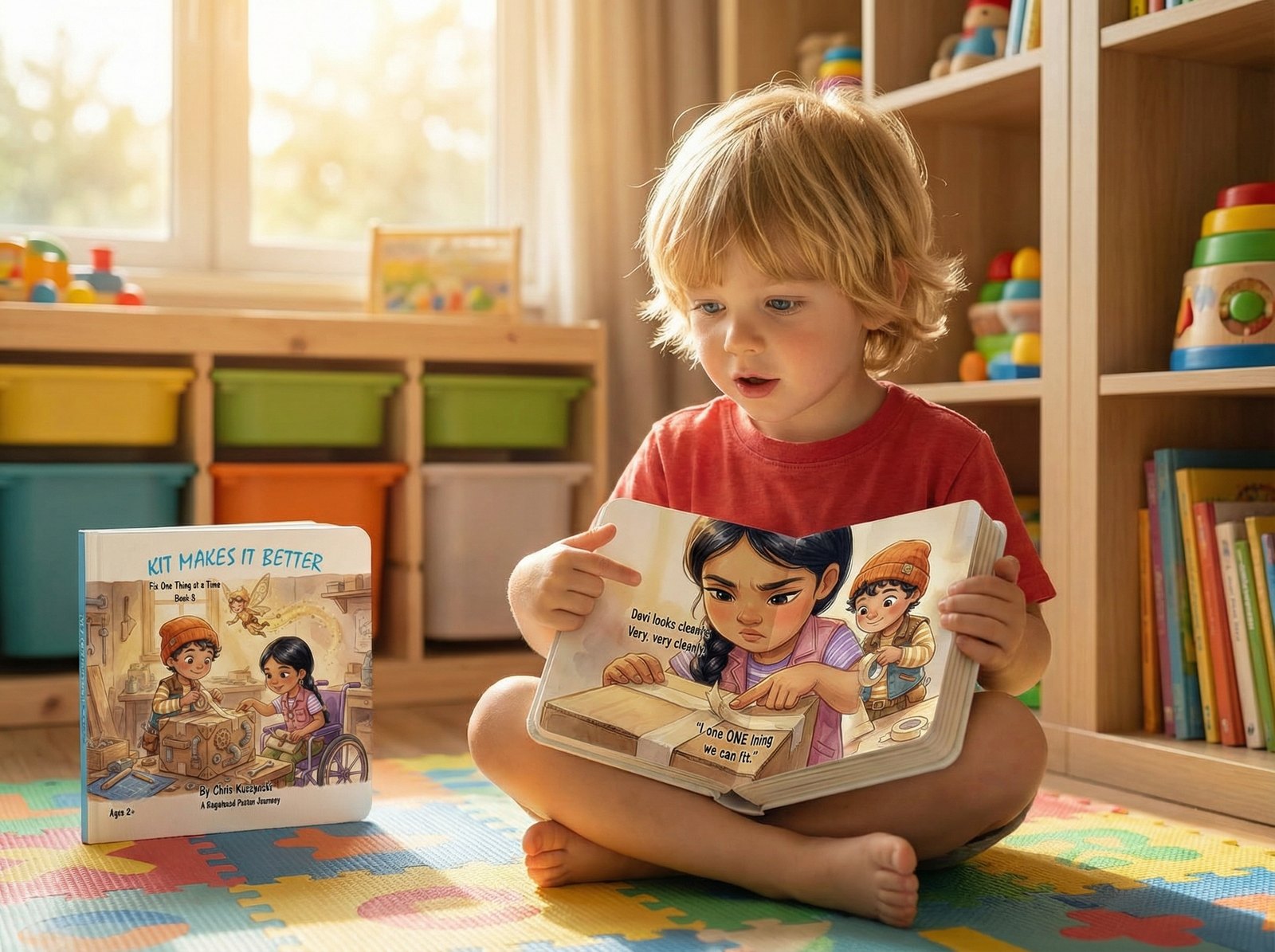
Why is the duck yellow. It is the ninetieth night of bedtime reading with the same book and the same question, and you have answered it eighty-nine times. You are tired, and somewhere in the back of your mind is the worry that the same book every night is a rut and a better parent would be rotating the library.
The leading authority in early childhood asks for exactly this kind of revisiting, in so many words, and the research on reading together rates the question-and-answer loop as the technique with the strongest evidence. The ninetieth night is not a rut. It is the practice. Here is what the standard says, what the studies found, and one book built to leave the space the loop needs.
Bedtime reading and what NAEYC says about revisiting
NAEYC’s 2020 position statement on developmentally appropriate practice has a line about curriculum that reads like a defense of the same bedtime book:
“The curriculum should provide both breadth and depth with multiple opportunities to revisit concepts and experiences, rather than rapidly progressing through a wide but shallow set of experiences.”
NAEYC, Developmentally Appropriate Practice, position statement, 2020, p. 13
The same statement lists what the revisiting builds. “Studies find clear links between play and foundational capacities such as working memory, self-regulation, oral language abilities, social skills, and success in school” (NAEYC, 2020, p. 9), and it names picture books that “depict communities and situations relevant to children’s lives” as “useful starting points” (p. 13). Depth over breadth, oral language, a familiar situation. That is a three-year-old asking about the duck.
What the research says about the loop
What gets trained in the bedtime loop is not literacy first. It is the social safety of the question: the child learns, hundreds of nights in a row, that asking is a normal, welcome thing to do in front of an adult who matters to them. The What Works Clearinghouse, the U.S. Department of Education’s evidence review, has looked at the loop twice.
| Report | The practice, in the report’s words | What it found |
|---|---|---|
| Dialogic reading WWC, 2007 |
“the adult and the child switch roles so that the child learns to become the storyteller with the assistance of the adult who functions as an active listener and questioner” (p. 1) | “positive effects on oral language” (p. 1), the review’s highest rating, resting on three studies that met its strongest design standard (p. 31) |
| Shared book reading WWC, 2015 |
“an adult reads a book to an individual child or a group of children and uses one or more planned or structured interactive techniques to actively engage the children in the text” (p. 1) | Evidence base for language development rated “medium to large”; effects across studies were mixed rather than uniform (p. 1) |
Chris Kuczynski, who wrote the books we recommend, has spent more than 20 years working with adult inventors and more than a decade as a preschool co-founder, and he makes one observation from both halves: the adults whose ideas become things are the ones who wonder out loud, and that habit is built or eroded in childhood. The bedtime loop is where a child practices it most reliably.
A book that meets the goal

Kit’s Little Sparks, Book 4
Kit Has Feelings: How Does That Make You Feel?
Bao asks “How does she feel?” on spread after spread, and the child answers before you can.
Some books are conversation-shaped and some are not. Conversation-shaped books leave space: short text, one prompt per page, an ending that hands the next move to the child. Book 4 is the clearest bedtime reading example in the series. Bao asks “How does she feel?” on spread after spread, and by the third night the child answers before you finish the question, which is the storyteller switch the research describes, arrived at on its own. Book 1, Kit’s Big Curiosity, is the other one: it ends with “What will YOU see?” and stops there, so the last word of the night is the child’s.
How the book meets what the standard asks for. NAEYC asks for depth and revisiting; a one-question-per-page book rewards the ninetieth reading, because the answers change as the child does. The dialogic reading report asks for the roles to switch; a book that asks its question out loud makes the switch happen without a technique to remember. And the shared reading report says the interaction is what counts, so a short book read with a question beats a long book read straight through.
Chris Kuczynski wrote about the bedtime loop for families on the Little Sparks site in Reading Aloud at Bedtime. This post is the classroom side of that conversation. The same loop runs at story time in preschool classrooms everywhere, with the same books.
What you can do
- Answer the question, then re-read the page. The page is not the lesson. The question was.
- Ask your own question back, but only one. “What do you think Kit will do next?” Wait. Do not answer your own question. The four seconds of silence is the lesson.
- Be wrong on purpose once a week. Read a word slightly wrong and let your child catch you. The pleasure of correcting an adult is real, and it builds the muscle of trusting their own observation.
Tonight, when the duck question comes for the ninety-first time, answer it. Then re-read the page.
References
- Kuczynski, C. (2026, August 7). Reading aloud at bedtime: What more than 20 years with inventors taught me about curiosity. The Inventor’s Desk. littlesparksbooks.com/blogs/news/reading-aloud-at-bedtime-curiosity
- National Association for the Education of Young Children. (2020). Developmentally appropriate practice [Position statement]. Web version at naeyc.org. Original PDF. Archived copy on littlesparksbooks.com (PDF), saved in case the original moves.
- What Works Clearinghouse. (2007). Dialogic reading (WWC Intervention Report). U.S. Department of Education, Institute of Education Sciences. Original PDF. Archived copy on littlesparksbooks.com (PDF), saved in case the original moves.
- What Works Clearinghouse. (2015). Shared book reading (WWC Intervention Report). U.S. Department of Education, Institute of Education Sciences. Original PDF. Archived copy on littlesparksbooks.com (PDF), saved in case the original moves.
Written by Chris Kuczynski. The books recommended here are his.
Chris Kuczynski is an engineer turned registered patent attorney, a preschool co-founder, and a dad. He is the author of Kit’s Little Sparks, a 20-book STEM series that gives children ages 2 to 4 the social and emotional foundations of the inventor’s mindset. It is the first of four age-tiered series for readers ages 2 to 12.