You ask what happened at school today. “Nothing.” Ten minutes later, at the sink, a whole story comes out: a cup, painted flowers, a bow that took three tries. The story was there the whole time. What was missing was the question that opens it, and that question is where a family partnership starts.
The people who set the standard for early childhood education have a name for the thing that question is part of. They call it a reciprocal partnership with families, a family partnership that runs both ways, and they put it second on their list of what a good program does. What follows is what they mean by it, what the research says about the simplest way to build one, and one picture book that hands you the question.
What NAEYC says about family partnership
The National Association for the Education of Young Children, NAEYC, is the body the early childhood field organizes itself around, and its position statement on developmentally appropriate practice, adopted in April 2020, is the document that sets the standard. Its second guideline is titled “Engaging in Reciprocal Partnerships with Families and Fostering Community Connections,” and it opens with a plain claim:
“Developmentally appropriate practice requires deep knowledge about each child, including the context within which each child is living. Educators acquire much of this knowledge through respectful, reciprocal relationships with children’s families.”
NAEYC, Developmentally Appropriate Practice, position statement, 2020, p. 18
Reciprocal is the word that matters. The statement asks educators to keep “regular, frequent, two-way communication” with families and to recognize “that the forms of communication may differ for each family” (NAEYC, 2020, p. 18). Information flows both ways, not only from the classroom to the kitchen table. The same statement notes that “picture books and other learning materials that depict communities and situations relevant to children’s lives can be useful starting points” (NAEYC, 2020, p. 13). A book is a two-way channel when the same book lives in both places.
California says the same thing in its 2024 Preschool/Transitional Kindergarten Learning Foundations. The Approaches to Learning domain includes a section for teachers titled “Collaborate with Families” (California Department of Education, 2024).
What the research says about reading together
The What Works Clearinghouse, the U.S. Department of Education’s evidence review, has looked twice at what happens when an adult and a young child read a picture book together.
| Report | The practice, in the report’s words | What it found |
|---|---|---|
| Dialogic reading WWC, 2007 |
“the adult and the child switch roles so that the child learns to become the storyteller with the assistance of the adult who functions as an active listener and questioner” (p. 1) | “positive effects on oral language” (p. 1), the review’s highest rating, resting on three studies that met its strongest design standard (p. 31) |
| Shared book reading WWC, 2015 |
“an adult reads a book to an individual child or a group of children and uses one or more planned or structured interactive techniques to actively engage the children in the text” (p. 1) | Evidence base for language development rated “medium to large”; effects across studies were mixed rather than uniform (p. 1) |
The mixed result is the honest state of the science, and the useful part of it: the act of reading is not the ingredient. The interaction is. Same book, same voice, plus a question.
A book that meets the goal

Kit’s Little Sparks, Book 16
Kit Gives It Away: The Joy of Making Something for Someone Else
Kit makes something for Grandma Rosa, not for himself. A book that a school can read aloud and only a family can finish.
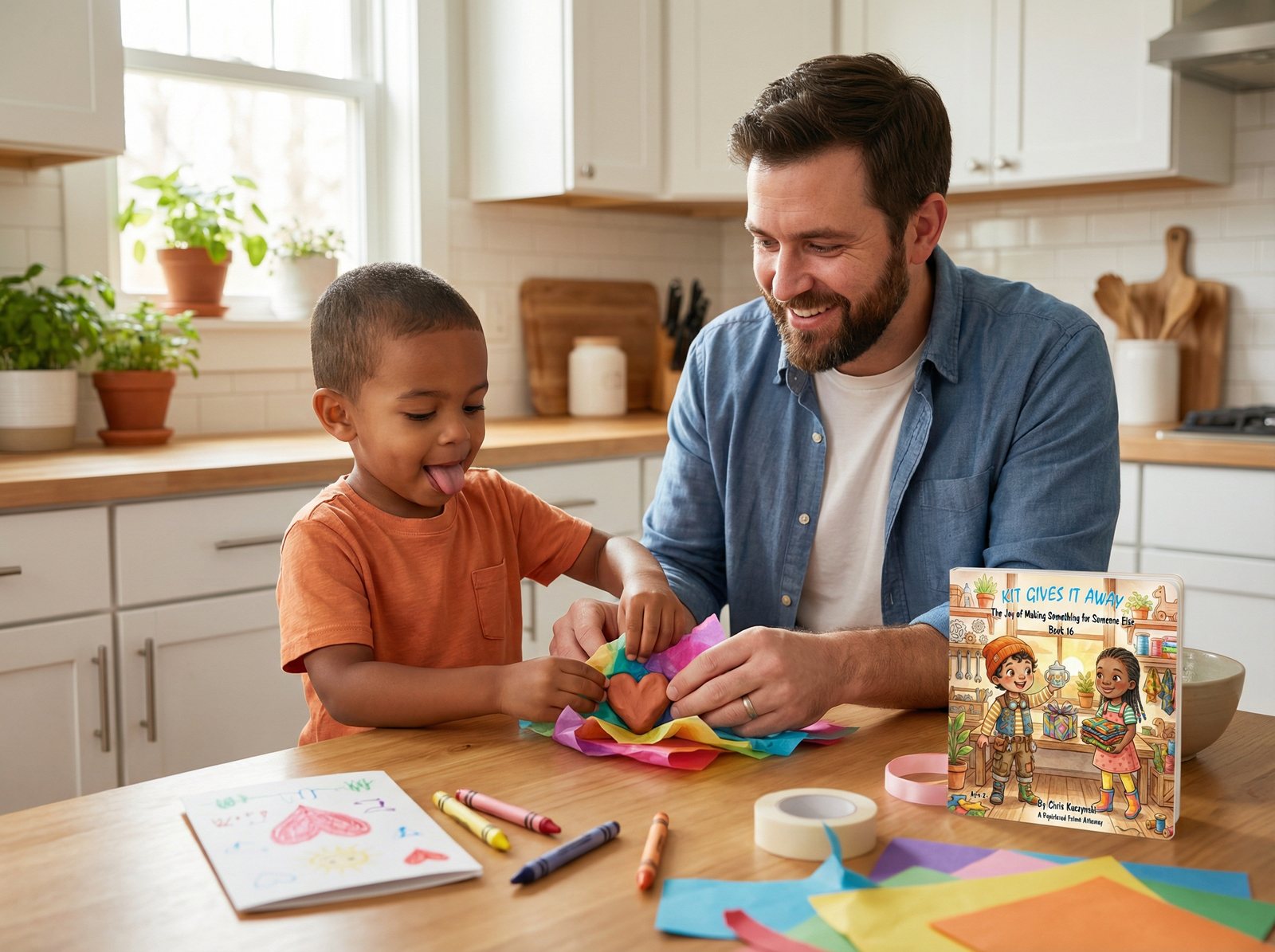
Grandma Rosa unwraps the fabric. She finds the painted cup, and her hand goes to her heart. “You MADE this? For ME?” That page is the one to think about when a school talks with families about partnership. Kit wants to make something for Grandma Rosa, not for himself. Ama shows him how to wrap the gift in fabric and tie the bow. The gift is a Steady Sippy with tiny painted flowers, because Grandma loves flowers. A school can read that book aloud, and preschool classrooms everywhere read books like it every week. Only a family can do it: choose the person, paint the cup, watch the hand go to the heart.
How the book meets what NAEYC asks of a family partnership. Every book in the series carries a QR code in the back, and every code opens the same page, the resource hub: a free read-aloud recording, a family activity sheet, and the educator guide for each of the 20 books. No login, no app. A classroom reads Book 16 in the morning. The child hears the same words in the car that evening. The family sheet has one activity and one question, and the child’s answer comes back to the classroom the next day. That is the two-way channel, built into the book. The recording and the question also do what the dialogic reading studies describe: the child becomes the storyteller, and the grown-up asks.
Chris Kuczynski wrote about the same guideline for families on the Little Sparks site in The QR Code Is the Take-Home. This post is the classroom side of that conversation.
What you can do
- Play the recording in the car, then read the book at bedtime. The same words twice in one day is how a three-year-old starts to “read” it back to you.
- Switch roles the way dialogic reading does. Ask “What is Kit making?” and let your child tell the page.
- Make one thing for one person this month. The Book 16 activity sheet has the steps. The bow matters more than the paint.
The activity sheet is on the resource hub tonight, and it is the smallest family partnership there is. Pick the person first. The cup can wait until the weekend.
References
- California Department of Education. (2024). California preschool/transitional kindergarten learning foundations: Approaches to learning. Original PDF. Archived copy on littlesparksbooks.com (PDF), saved in case the original moves.
- Kuczynski, C. (2026, September 11). The QR code is the take-home: Family engagement without another newsletter. The Inventor’s Desk. littlesparksbooks.com/blogs/news/family-engagement-read-aloud-qr-resources
- National Association for the Education of Young Children. (2020). Developmentally appropriate practice [Position statement]. Web version at naeyc.org. Original PDF. Archived copy on littlesparksbooks.com (PDF), saved in case the original moves.
- What Works Clearinghouse. (2007). Dialogic reading (WWC Intervention Report). U.S. Department of Education, Institute of Education Sciences. Original PDF. Archived copy on littlesparksbooks.com (PDF), saved in case the original moves.
- What Works Clearinghouse. (2015). Shared book reading (WWC Intervention Report). U.S. Department of Education, Institute of Education Sciences. Original PDF. Archived copy on littlesparksbooks.com (PDF), saved in case the original moves.
Written by Chris Kuczynski. The books recommended here are his.
Chris Kuczynski is an engineer turned registered patent attorney, a preschool co-founder, and a dad. He is the author of Kit’s Little Sparks, a 20-book STEM series that gives children ages 2 to 4 the social and emotional foundations of the inventor’s mindset. It is the first of four age-tiered series for readers ages 2 to 12.