Someone at the park says it kindly: three is too young for STEM, let them play. You nod, because it sounds right, and then your three-year-old spends the next ten minutes dropping the same leaf from the same bench to watch it spin, saying “again” every time. That is a repeated trial with one variable held constant. Nobody told them to do it.
The two documents that define early education in this state answer the park question in writing. NAEYC says every child from birth has the right to learning across all content areas. California publishes science foundations written for three-year-olds. Here is what they say, what STEM actually looks like at three, and one picture book that treats a tipped-over cup as a puzzle.
Too young for STEM? What NAEYC says
NAEYC’s 2020 position statement on developmentally appropriate practice opens with a statement of rights, and the age range is the point:
“Each and every child, birth through age 8, has the right to equitable learning opportunities–in centers, family child care homes, or schools–that fully support their optimal development and learning across all domains and content areas.”
NAEYC, Developmentally Appropriate Practice, position statement, 2020, p. 5
All content areas, from birth. The statement is equally clear that the method for a three-year-old is not a worksheet: it defines developmentally appropriate practice as “a strengths-based, play-based approach to joyful, engaged learning” (NAEYC, 2020, p. 5). California agrees and gets specific. Its 2024 Preschool/Transitional Kindergarten Learning Foundations include an entire Science domain “for three-to-five-and-a-half-year-old children” (California Department of Education, 2024, p. 1), and it starts where the leaf started: “Young children have a sense of wonder and natural curiosity about objects and events in their environment” (p. 4). The state expects three-year-olds to “explore concepts related to living things and nonliving things, the weather, objects in the sky” and “how their actions impact the environment around them” (p. 4).
What STEM looks like at three
STEM for a three-year-old is not STEM for a second-grader shrunk down. Books for older children introduce content: the water cycle, the food chain, simple machines. Those are facts, and a three-year-old does not need them yet. They need habits of mind, and the habits are social and emotional before they are anything else. Notice the world. Ask why, as a tool rather than a power play. Spot puzzles in everyday things. Try something: a scribble, a piece of tape, a guess. Try again when it does not work, and feel frustrated first, out loud, because that is allowed. Watching a leaf fall and saying “again,” pulling apart a cardboard tube to see what is inside, stacking blocks and noticing they fall, and telling you a friend looked sad are all data collection or a hypothesis test. The last one is the one most STEM lists leave out, and it is the one that decides whether a child will ever share what they build.
A book that meets the goal

Kit’s Little Sparks, Book 3
Kit Sees A Puzzle: Uh Oh! I See A Puzzle
The reframe that does the most work at three: problems are puzzles, and puzzles are fun.
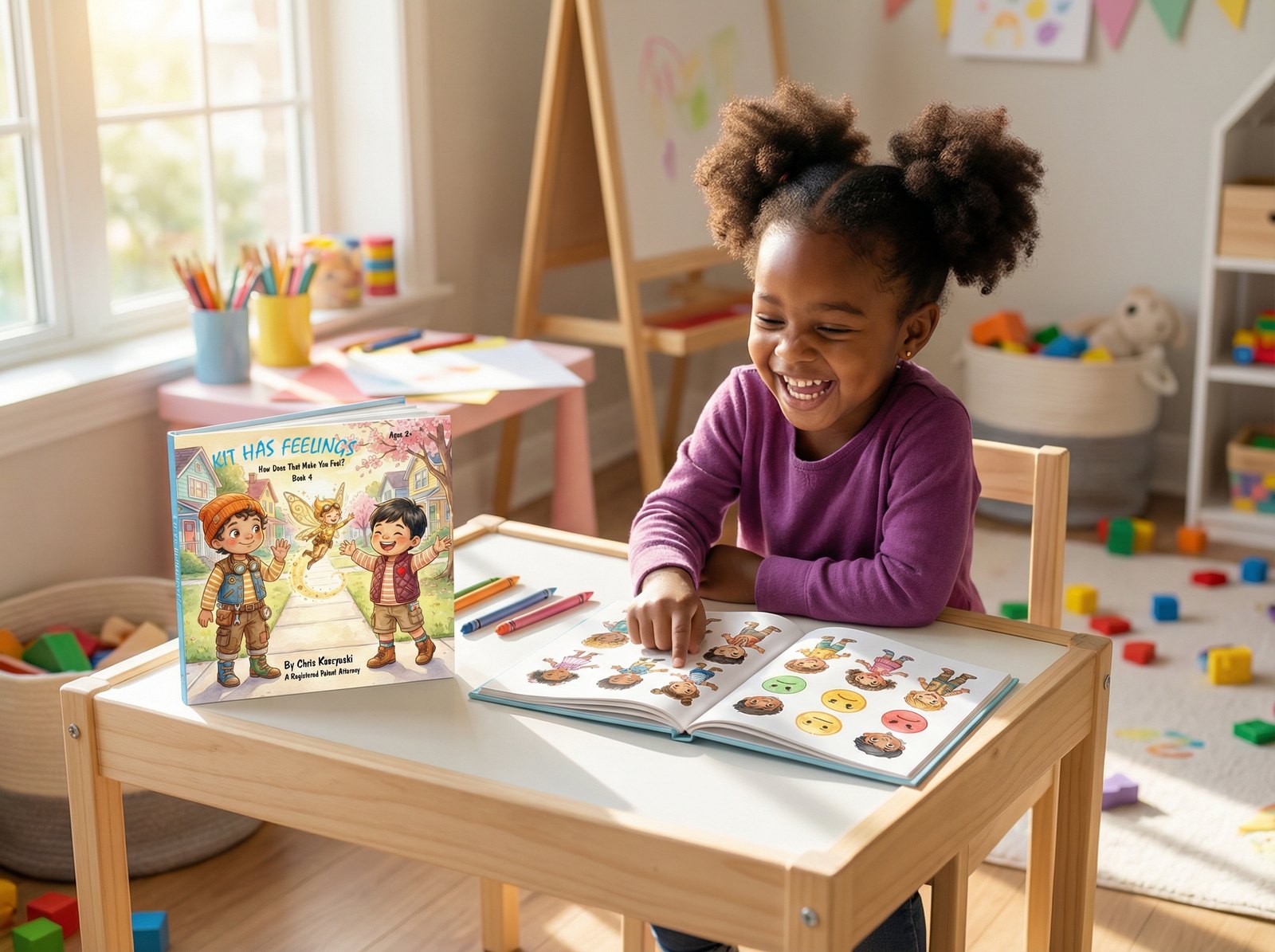
Book 3 walks Kit and Naya through the neighborhood spotting puzzles. A juice cup that tips. A jar that will not open. A dog walker tangled in three leashes. Each one gets the same reaction, “Uh oh! I see a puzzle!”, and the same question on the spread, one per page, sized for a three-year-old to answer. It is the entry point of the Wondering phase, Books 1 to 4, which is the series’ answer to the park question: the first four books contain no facts to learn and four habits to catch. Book 1 ends with a question for the child, “What will YOU see?”, and the next time you walk past a ceiling fan together you will find out.
How the book meets what the standard asks for. NAEYC asks for learning across all content areas from birth, delivered through play. California expects a three-year-old to explore how things work and how their own actions change the world around them. Book 3 is the answer to too young for STEM, and it is both: a science practice, defining the problem, in the shape of a game, with no vocabulary to memorize and a puzzle a child can carry to the sink. The habit it plants is the one the standards name first for the youngest children, wonder about ordinary objects and events, and it is the most upstream thing a family can do.
Chris Kuczynski answered the park question for families on the Little Sparks site in Are Toddlers Too Young for STEM Books? This post is the classroom side of that conversation, and preschool curriculum everywhere is built on the same answer: not too young, differently shaped.
What you can do
- Let the leaf drop ten times. Say “again?” with them. A repeated trial is science, and the tenth drop is the one where they predict.
- Call it a puzzle. The next time the cup tips, try Kit’s line before the paper towel: “Uh oh! I see a puzzle!” Then wait for a solution, any solution.
- Count the friend’s face as data. “You noticed she looked sad.” Noticing people is the STEM habit that decides whether a child shares what they build.
Next time at the park, let them keep dropping the leaf. Then read Book 3 in the car on the way home. Nobody is too young for STEM.
References
- California Department of Education. (2024). California preschool/transitional kindergarten learning foundations: Science. Original PDF. Archived copy on littlesparksbooks.com (PDF), saved in case the original moves.
- Kuczynski, C. (2026, July 3). Are toddlers too young for STEM books? A patent attorney’s honest answer. The Inventor’s Desk. littlesparksbooks.com/blogs/news/are-toddlers-too-young-for-stem-books
- National Association for the Education of Young Children. (2020). Developmentally appropriate practice [Position statement]. Web version at naeyc.org. Original PDF. Archived copy on littlesparksbooks.com (PDF), saved in case the original moves.
Written by Chris Kuczynski. The books recommended here are his.
Chris Kuczynski is an engineer turned registered patent attorney, a preschool co-founder, and a dad. He is the author of Kit’s Little Sparks, a 20-book STEM series that gives children ages 2 to 4 the social and emotional foundations of the inventor’s mindset. It is the first of four age-tiered series for readers ages 2 to 12.