
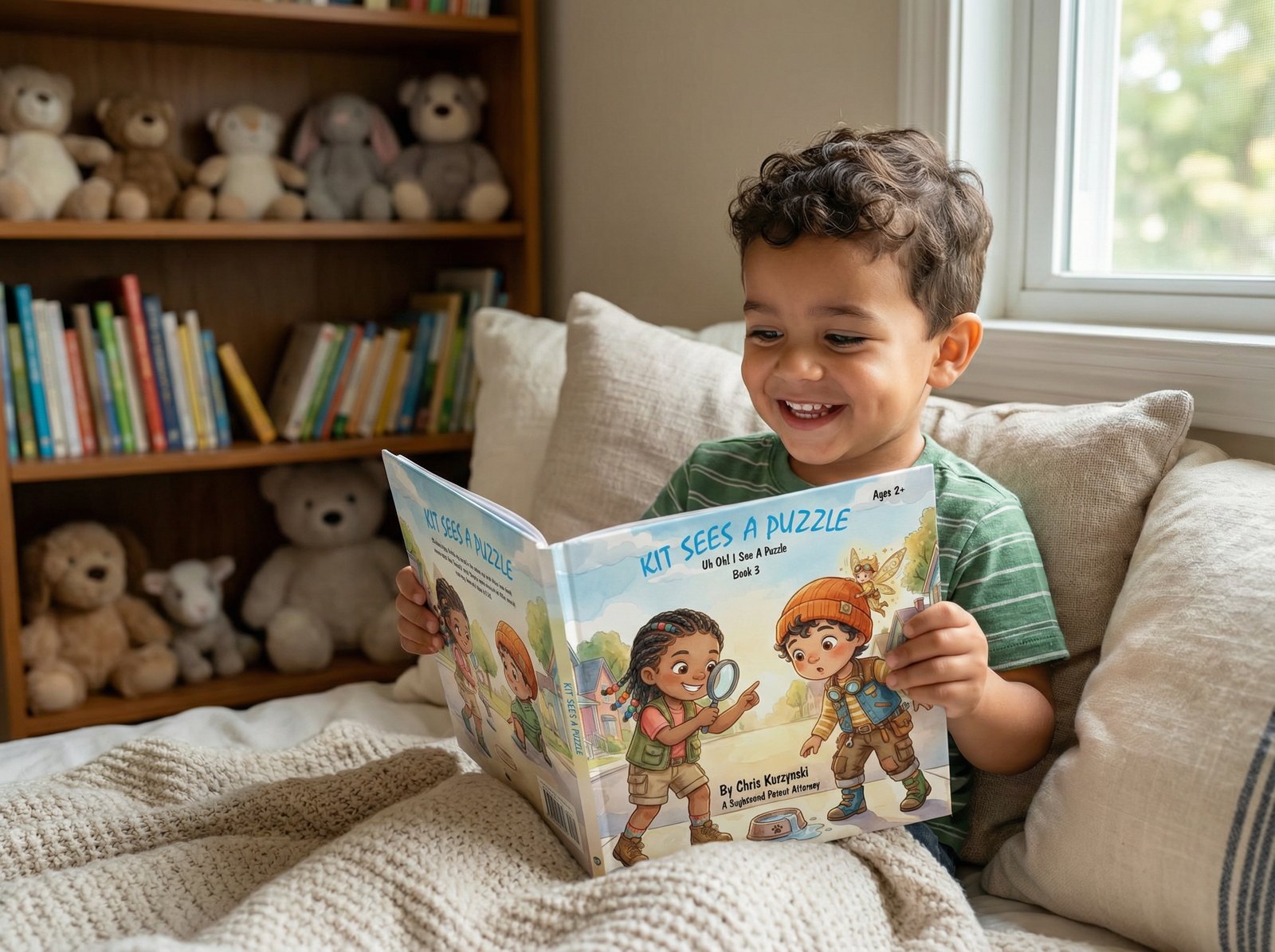
Page four, and your child has discovered that the floor is full of more interesting things than the book you are holding. By page six they are across the room with a truck. You keep reading to an empty lap and wonder whether reading time is the problem or you are.
Neither. The leading authority in early childhood calls play, not sitting, the central teaching practice for this age, and the research on reading together says the ingredient is the interaction, not the finished book. Here is what that means for the child who will not sit still, and three books built for it.
Sit still? What NAEYC says about how young children learn
NAEYC’s 2020 position statement on developmentally appropriate practice does not describe learning as sitting and receiving. It describes it as play:
“Play (e.g., self-directed, guided, solitary, parallel, social, cooperative, onlooker, object, fantasy, physical, constructive, and games with rules) is the central teaching practice that facilitates young children’s development and learning.”
NAEYC, Developmentally Appropriate Practice, position statement, 2020, p. 9
The statement highlights “learning experiences that are meaningful to each child and that provide active engagement through play, exploration, and inquiry” (NAEYC, 2020, p. 4), and it is careful about balance: “Neither end of the continuum is effective by itself” between self-directed play and direct instruction (p. 9). A read-aloud that follows a moving child across the room is not a failed lesson. It is the statement’s continuum in a living room.
What the research says the ingredient is
The What Works Clearinghouse, the U.S. Department of Education’s evidence review, has examined reading together twice, and neither report scores the number of pages finished.
| Report | The practice, in the report’s words | What it found |
|---|---|---|
| Dialogic reading WWC, 2007 |
“the adult and the child switch roles so that the child learns to become the storyteller with the assistance of the adult who functions as an active listener and questioner” (p. 1) | “positive effects on oral language” (p. 1), the review’s highest rating, resting on three studies that met its strongest design standard (p. 31) |
| Shared book reading WWC, 2015 |
“an adult reads a book to an individual child or a group of children and uses one or more planned or structured interactive techniques to actively engage the children in the text” (p. 1) | Evidence base for language development rated “medium to large”; effects across studies were mixed rather than uniform (p. 1) |
The common thread is the interactive technique, the question and the switch of roles. That can happen on page four, on the floor, or with the book held sideways. It cannot happen if the adult is reading to an empty lap.
A book that meets the goal

Kit’s Little Sparks, Book 3
Kit Sees A Puzzle: Uh Oh! I See A Puzzle
One question per spread. Problems are puzzles, and puzzles are fun.
Three rules work with a child who will not sit. The book is not the lesson plan; the conversation is. If your child walks away mid-page, follow them across the room with the book still open and ask, “What did you notice over here?” One question per page is enough. “What is happening, what color is the cup, what is Kit feeling, why is Sparks glowing?” is four questions, and a toddler picks one or none. Ask the question the page was built around and leave space. And build a route, not a script. You may start on page four, jump to page ten because your child pointed at a picture there, and finish on the cover because that is what they want to talk about.
Three books are built for that kind of reading. Book 3, Kit Sees A Puzzle, carries one question per spread. Book 6, Kit Builds Something, has concrete actions on every page: tape, cardboard, hands. Book 7, Kit Tries Again, is built around a single emotional beat: Kit’s invention collapses, his lip wobbles, and the twins Sam and Suki turn every crash into “OOPS! ALMOST!”
How the book meets what the standard asks for. NAEYC’s continuum runs from self-directed play to direct instruction and says neither end works alone. A book with one question per spread sits in the middle, and it does not need the child to sit still: the page supplies the prompt, the child supplies the answer, and the adult can ask it from anywhere in the room. That is the dialogic switch the research rates highest, made portable. Every book in the series also comes with a free read-aloud recording, in case you want to hear the cadence done right before tomorrow morning.
Chris Kuczynski wrote the three rules for families on the Little Sparks site in How to Read STEM Books With a Toddler Who Won’t Sit Still. This post is the classroom side of that conversation, and it is how story time runs in preschool classrooms everywhere: the children move, the question follows them.
What you can do
- Follow the child, not the page. Book open, across the room, one question about whatever they are looking at.
- Ask one question per page and stop. The four seconds of silence after it is where the answer comes from.
- Let them run the route. Page four, then ten, then the cover. A book read out of order is still a book read.
Tomorrow morning, when they leave on page four, take the book with you. Nobody has to sit still.
References
- Kuczynski, C. (2026, June 8). How to read STEM books with a toddler who won’t sit still. The Inventor’s Desk. littlesparksbooks.com/blogs/news/how-to-read-stem-books-with-a-toddler-who-wont-sit-still
- National Association for the Education of Young Children. (2020). Developmentally appropriate practice [Position statement]. Web version at naeyc.org. Original PDF. Archived copy on littlesparksbooks.com (PDF), saved in case the original moves.
- What Works Clearinghouse. (2007). Dialogic reading (WWC Intervention Report). U.S. Department of Education, Institute of Education Sciences. Original PDF. Archived copy on littlesparksbooks.com (PDF), saved in case the original moves.
- What Works Clearinghouse. (2015). Shared book reading (WWC Intervention Report). U.S. Department of Education, Institute of Education Sciences. Original PDF. Archived copy on littlesparksbooks.com (PDF), saved in case the original moves.
Written by Chris Kuczynski. The books recommended here are his.
Chris Kuczynski is an engineer turned registered patent attorney, a preschool co-founder, and a dad. He is the author of Kit’s Little Sparks, a 20-book STEM series that gives children ages 2 to 4 the social and emotional foundations of the inventor’s mindset. It is the first of four age-tiered series for readers ages 2 to 12.