
The kindergarten readiness checklist arrives in the spring: letters, numbers to twenty, a name written in crayon, shoes tied if possible. You drill the letters in the car. Then you visit the classroom and watch a teacher ask a small boy to tell the group what he built at the block table, and he cannot make a sound. Nothing on the checklist covered that.
NAEYC’s own guidance warns that the early grades tend to chase the checklist at the expense of everything else, and California’s plan for the years before kindergarten says the readiness that lasts comes from a different kind of preparation. One picture book we recommend is about the one skill the transition actually needs, and it rehearses that skill on a row of stuffed animals first.
Kindergarten readiness, the way NAEYC sees the early grades
NAEYC’s 2020 position statement on developmentally appropriate practice covers children from birth through age eight, which means it has something to say about kindergarten itself. Its warning is direct:
“Kindergartens and grades 1-3 tend to be considered elementary or primary education, and, as such, may have increasingly prioritized cognitive learning at the expense of physical, social, emotional, and linguistic development.”
NAEYC, Developmentally Appropriate Practice, position statement, 2020, p. 9
The statement’s answer is that all the domains “are important; each domain both supports and is supported by the others” (NAEYC, 2020, p. 9). A child who can stand up, wait for a turn, take a breath when it goes wrong and try again is bringing the social, emotional and linguistic half to kindergarten, and that half is what the checklist leaves out. California’s Master Plan for Early Learning and Care, the document behind the state’s expansion of transitional kindergarten to every four-year-old, puts the payoff plainly: “High-quality preschool programs can increase levels of school readiness at kindergarten entry and can improve long-term school performance” (California Health and Human Services Agency, 2020, p. 17). The 2024 Preschool/TK foundations were written to cover both settings with one document, and their Approaches to Learning domain, engagement and perseverance, is the readiness the teacher was looking for at the block table.
What kindergarten readiness looks like to a teacher
Ask a kindergarten teacher what a ready child looks like and letters and numbers come up late in the answer. What comes up first: can the child stand in front of others and say what they did? Can they wait for a turn, take a breath when it goes wrong, and try again? Those are the Approaches to Learning foundations, engagement and perseverance, wearing school clothes. No screening tool measures them, which is why they are easy to skip in the spring and hard to do without in September.
A book that meets the goal

Kit’s Little Sparks, Book 17
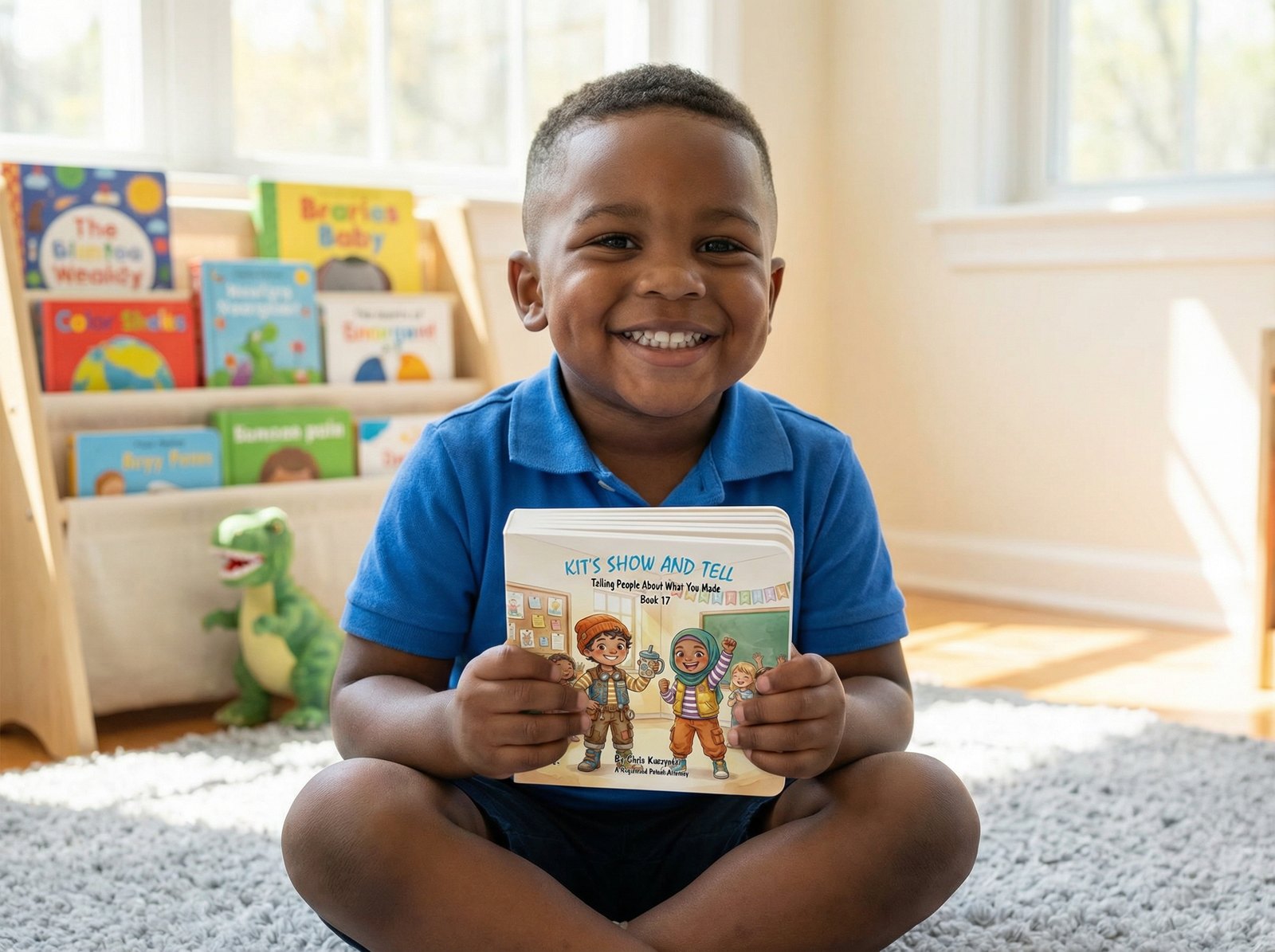
Kit’s Show and Tell: Telling People About What You Made
Four steps, practiced on stuffed animals first. Then three sentences to a whole room.
Tomorrow is show and tell and Kit is nervous. What if the words do not come out? Layla, a girl with a sticker-covered megaphone, breaks it into four steps. Say your name. Say what you made. Say why it is cool. Smile. Knowing the steps and doing them are two different things, so Kit practices. First on his stuffed animals, lined up on the bed. His voice wobbles. Then on his little sister Mia, who claps. Then in the mirror, and the smile becomes real. At school, deep breath, three sentences, and the class cheers: “I am Kit. I made The Steady Sippy. It holds your juice so it never tips over.”
Book 20, Kit’s Promise, is the series finale. Every friend from the nineteen books before it comes back, and Kit says the Inventor’s Promise out loud in front of all of them. It is written as a beginning, not an ending. A child who has read all twenty arrives at TK or kindergarten with a word for themselves and a room of characters who already said it first.
How the book meets what the standard asks for. NAEYC warns that the early grades over-weight the cognitive checklist. Book 17 is about the other half of kindergarten readiness: standing up, speaking, and the rehearsal that makes brave possible. The book is not about the invention. It is about practice, and about the fact that brave is a thing you try on stuffed animals first. That is engagement and perseverance from California’s Approaches to Learning domain in a form a four-year-old can copy, and it is the first conversation a child can have with a new teacher: “I am Sam, I built a tower, it was tall.”
Chris Kuczynski wrote about the same transition for families on the Little Sparks site in Show and Tell Is the Readiness Skill Nobody Tests. This post is the classroom side of that conversation. Transitional kindergarten and kindergarten classrooms are built for the handoff the Master Plan describes.
What you can do
- Run Layla’s four steps at dinner once a week. Name, what you made, why it is cool, smile. Thirty seconds. Stuffed animals are an acceptable first audience.
- Take the same four steps to the first day. A child who can say “I am Sam, I built a tower, it was tall” to a new teacher has a first conversation ready.
- Read Book 20 the week before school starts. Then ask which friend they would bring.
The free educator guide for Book 17 keeps three stuffed animals seated as a permanent practice audience and sends the mirror step home on the family sheet. Line up the animals tonight. That is kindergarten readiness practice.
References
- California Department of Education. (2024). California preschool/transitional kindergarten learning foundations: Approaches to learning. Original PDF. Archived copy on littlesparksbooks.com (PDF), saved in case the original moves.
- California Health and Human Services Agency. (2020). Master plan for early learning and care: Making California for all kids. Resource page at chhs.ca.gov. Archived copy on littlesparksbooks.com (PDF), saved in case the original moves.
- Kuczynski, C. (2026, August 21). Show and tell is the readiness skill nobody tests: Kindergarten transition and Books 17 and 20. The Inventor’s Desk. littlesparksbooks.com/blogs/news/kindergarten-transition-show-and-tell-books-17-20
- National Association for the Education of Young Children. (2020). Developmentally appropriate practice [Position statement]. Web version at naeyc.org. Original PDF. Archived copy on littlesparksbooks.com (PDF), saved in case the original moves.
Written by Chris Kuczynski. The books recommended here are his.
Chris Kuczynski is an engineer turned registered patent attorney, a preschool co-founder, and a dad. He is the author of Kit’s Little Sparks, a 20-book STEM series that gives children ages 2 to 4 the social and emotional foundations of the inventor’s mindset. It is the first of four age-tiered series for readers ages 2 to 12.