Why is the sky blue. Why do dogs bark. Why is that man tall. Why, when you answer, why. By the fortieth one in the car you have run out of answers and started to wonder whether the point was ever the answer. It was not, or not only. A three-year-old asks why for two reasons. One is information. The other is that they have just discovered they can steer a conversation, and they are testing what the tool does. That is curiosity, and the state has a name for it.
California’s preschool foundations have a name for this phase and put it first in the domain that describes how children learn. One picture book we recommend starts on the same page: a child discovering that the world is full of interesting things.
What California calls curiosity
The 2024 California Preschool/Transitional Kindergarten Learning Foundations open the Approaches to Learning domain with a strand called Motivation to Learn, and its first sub-strand is Curiosity and Interest. Foundation 1.1 describes the early level, ages three to four, this way:
“Express interest in some familiar and new objects, people, and activities in their immediate environment.”
California Department of Education, Preschool/Transitional Kindergarten Learning Foundations: Approaches to Learning, 2024, p. 18
By four to five the foundation expects the child to “express interest in a broader range of familiar and new objects, people, and activities by exploring more extensively with their senses, describing their observations in greater detail, and asking more detailed questions” (California Department of Education, 2024, p. 18). Asking more detailed questions is the goal, in the state’s own words. The document tells adults how to help: “Teachers can support children in developing and sustaining their curiosity by creating safe, inviting environments where wonder and discovery are valued” (p. 21), and it notes that “introducing a new activity with enthusiasm and wonder promotes excitement and curiosity in children” (p. 11). Wonder is contagious in both directions.
What the science foundations add
California’s Science foundations start from the same place: “Young children have a sense of wonder and natural curiosity about objects and events in their environment” (California Department of Education, 2024, Science, p. 4). The why is not a phase to survive. It is the raw material of the science domain, and the document’s advice to adults is to keep it alive rather than answer it into silence: “Teachers may ask an open-ended question, scaffold learning by making a suggestion or giving a prompt, or comment on what a child is doing” (p. 7). Notice what is not on that list: deliver the complete correct answer every time.
A book that meets the goal

Kit’s Little Sparks, Book 1
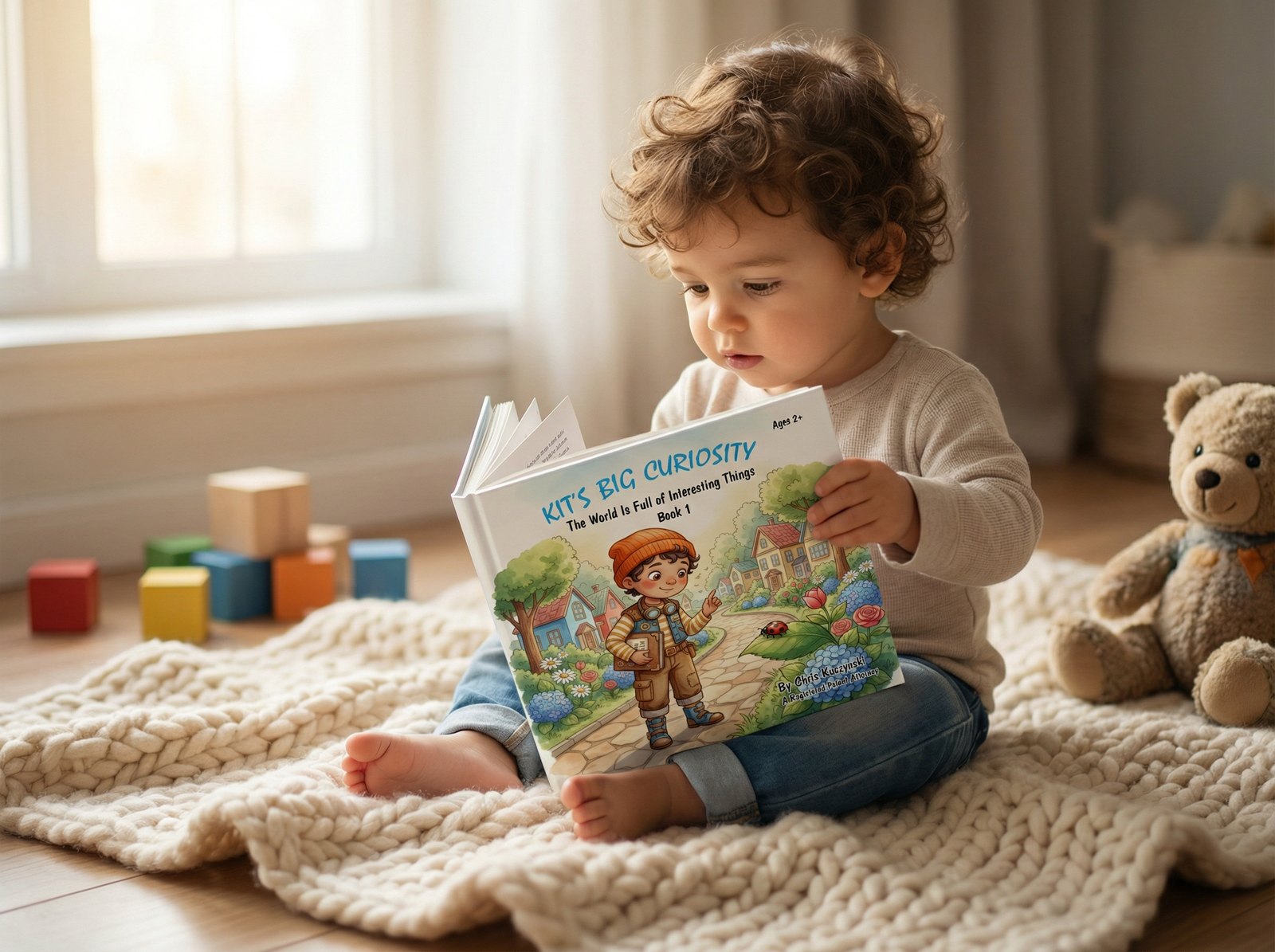
Kit’s Big Curiosity: The World Is Full of Interesting Things
The whole series starts here. A walk, four directions, and a question the book hands back to the child.
Book 1 is a walk. Up, a bird building a nest. Down, a flower in a crack. Left, a puddle. Right, a dog chasing its tail. Kit notices each one, and the book ends with the question handed to the reader: “What will YOU see?” It stops there. The activity in the back is the same walk in your own neighborhood, counting every “ooh.” Two books follow it in the Wondering phase. Book 3, Kit Sees A Puzzle, makes the reframe that does the most work: problems are puzzles, and puzzles are fun. Book 4, Kit Has Feelings, turns the same noticing toward people.
How the book meets what the standard asks for. The foundation asks a three-year-old to express interest in familiar and new things in their immediate environment, and a year later to describe observations and ask more detailed questions. Book 1 is that curiosity foundation in a story: a familiar street, four things to notice, and an ending that does not answer but asks. A book that closes on “What will YOU see?” leaves the why to the child, which is exactly where the foundation wants it. The books that work at this age share three features: a character the child can hold onto ten pages in, one question per book, and a pause inside the question for the child to answer. Book 1 has all three.
Chris Kuczynski wrote about the why phase for families on the Little Sparks site in Best STEM Books for Toddlers Who Ask Why About Everything. This post is the classroom side of that conversation. Curiosity is the first word in any good preschool curriculum for a reason.
What you can do
- Answer some, redirect some. “What do you think?” is a complete answer to the fortieth why. The skill being built is wondering together, not delivery of facts.
- Read slower than feels natural. The pause is the lesson. When your child asks a question mid-book, answer it, then re-read the page.
- Let your child “read” Book 1 back to you. They will narrate from memory and from the pictures. That is the goal.
After the book, take the walk. Up, down, left, right. Count the oohs.
References
- California Department of Education. (2024). California preschool/transitional kindergarten learning foundations: Approaches to learning. Original PDF. Archived copy on littlesparksbooks.com (PDF), saved in case the original moves.
- California Department of Education. (2024). California preschool/transitional kindergarten learning foundations: Science. Original PDF. Archived copy on littlesparksbooks.com (PDF), saved in case the original moves.
- Kuczynski, C. (2026, May 12). Best STEM books for toddlers who ask why about everything. The Inventor’s Desk. Read on littlesparksbooks.com
Written by Chris Kuczynski. The books recommended here are his.
Chris Kuczynski is an engineer turned registered patent attorney, a preschool co-founder, and a dad. He is the author of Kit’s Little Sparks, a 20-book STEM series that gives children ages 2 to 4 the social and emotional foundations of the inventor’s mindset. It is the first of four age-tiered series for readers ages 2 to 12.